Enzymecrew supplies enzyme ingredients to companies that formulate and sell industrial cleaning products: hard-surface and food-plant cleaners, enzymatic instrument cleaners, membrane cleaning products, degreasers and enzyme concentrates for cleaning service companies and distributors.
These buyers use enzymes to remove organic soils (protein, starch, fat and biofilm) that alkali, acid and solvent alone remove slowly or only by attacking the surface underneath. If that is the problem your product solves, send us the product, quantity and destination.
Request a quote - wholesale and bulk supply, quoted per order.
Where enzymes earn their place in industrial cleaners
| Cleaning product | Soil the enzyme targets | Business case for your customer |
|---|---|---|
| Enzymatic instrument cleaners (hospitals, sterilisation centres, device reprocessing) | Dried blood and tissue protein on instruments | Protein breaks down into soluble fragments that rinse away, so instruments come clean before disinfection and sterilisation |
| Membrane cleaning products (RO, UF, NF, MBR) | Organic fouling and biofilm on membranes | Restores flux and extends membrane life without the acid and alkali damage of aggressive chemical cleaning; fewer membrane replacements |
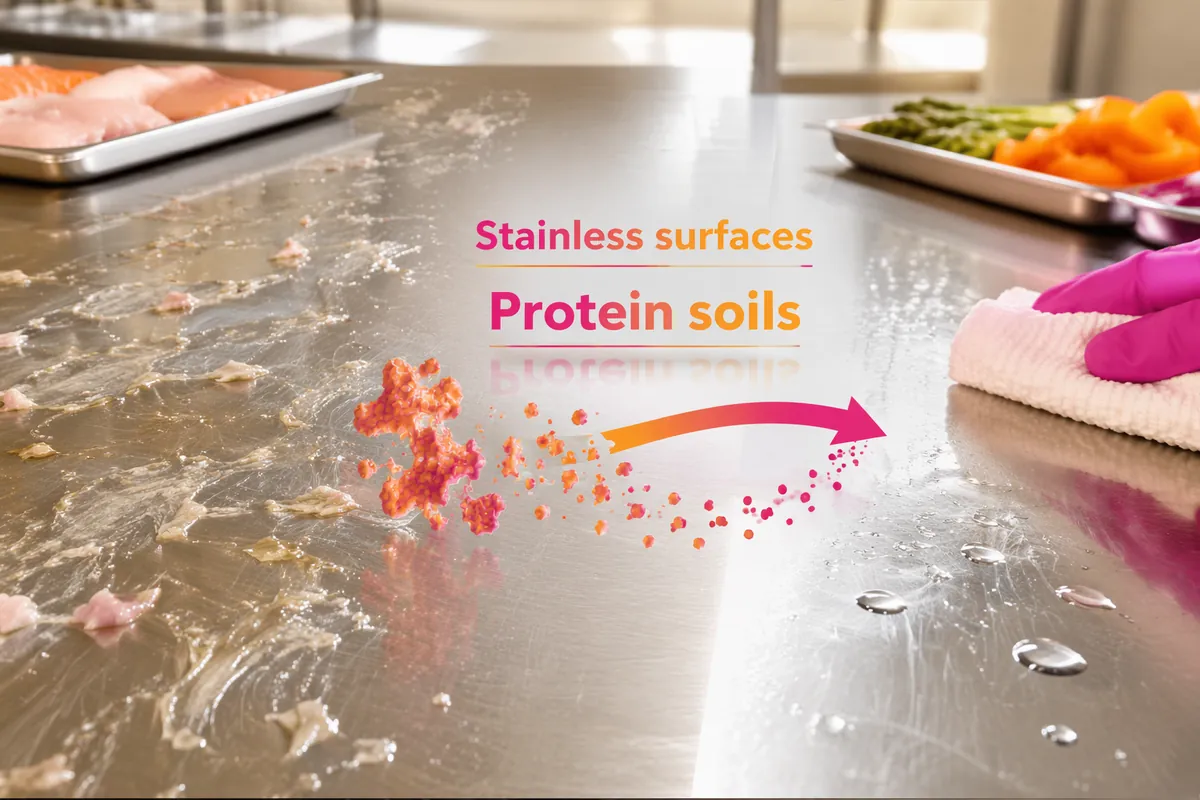
| Food-plant and kitchen surface cleaners | Protein, starch and fat films on stainless equipment | Faster cleanup with milder chemistry |
| Degreasers for food service and maintenance | Fats, oils and grease | Better grease release where solvent levels are being reduced |
Instrument cleaners: alkaline protease does the main work
In medical device cleaning, the hard soil is blood. Alkaline protease breaks blood protein into smaller, soluble peptides and amino acids, which is why it is the base enzyme of enzymatic instrument detergents. Buyers in this segment are hospitals, central sterilisation departments, medical device manufacturers and the cleaning service companies that support them.
What instrument-cleaner makers should settle before ordering:
- Protease type and activity grade that suits a near-neutral or mildly alkaline instrument detergent
- Combination enzymes: whether lipase and amylase are worth adding for fatty and starchy soils
- Foam: instrument detergents for ultrasonic baths and washer-disinfectors need low foam, so check the surfactant partner
- Liquid stability in the concentrate across your stated shelf life
Membrane cleaning: enzyme blends instead of harsh chemistry
Operators of reverse osmosis, ultrafiltration, nanofiltration and membrane bioreactor systems lose flux as organic matter and biofilm build up. The usual answer, aggressive acid and alkali cleaning, wears the membrane. Enzyme membrane cleaners target the organic foulants and the biofilm matrix instead.
Who buys them: water utilities and wastewater plants, MBR operators, breweries, juice and dairy processors, and biotech manufacturers that run membrane filtration. Formulators sell these products as pre-formulated liquid or powder blends in drums and containers.
What practitioners get wrong:
- Short soak times. Enzyme membrane cleaning is a soak, not a quick flush; heavy fouling may need an overnight soak.
- Wrong pH or temperature. The enzyme works within a moderate pH and warm temperature window; running it in a hot caustic clean destroys it.
- Expecting it to remove scale. Enzymes remove organic fouling and biofilm, not mineral scale; that still needs an acid step.
- Skipping the flux record. Measure flux before and after so your customer can see the result and reorder.
Questions to settle before you order
- Which soil is the real problem? Protein, starch, fat, biofilm or a mix decides the enzyme or blend.
- What is the product pH and does it contain oxidisers? Enzymes and strong oxidisers do not share a phase.
- Liquid or powder? Liquids need stabilisation for shelf life; powders need protected granules.
- How will your customer use it? Soak, spray, circulation or ultrasonic bath changes the contact time the enzyme gets.
- What volume and destination? We quote packs and lead time per order.
Request a quote
Tell us the product you make (or the soil it must remove), the quantity you expect to buy and the destination country. Add the product format, pH range and any ingredients the enzyme must sit alongside. We reply with pricing, pack options and lead time.


